

Loading website
00%
Data Discovery and Classification for DPDP with
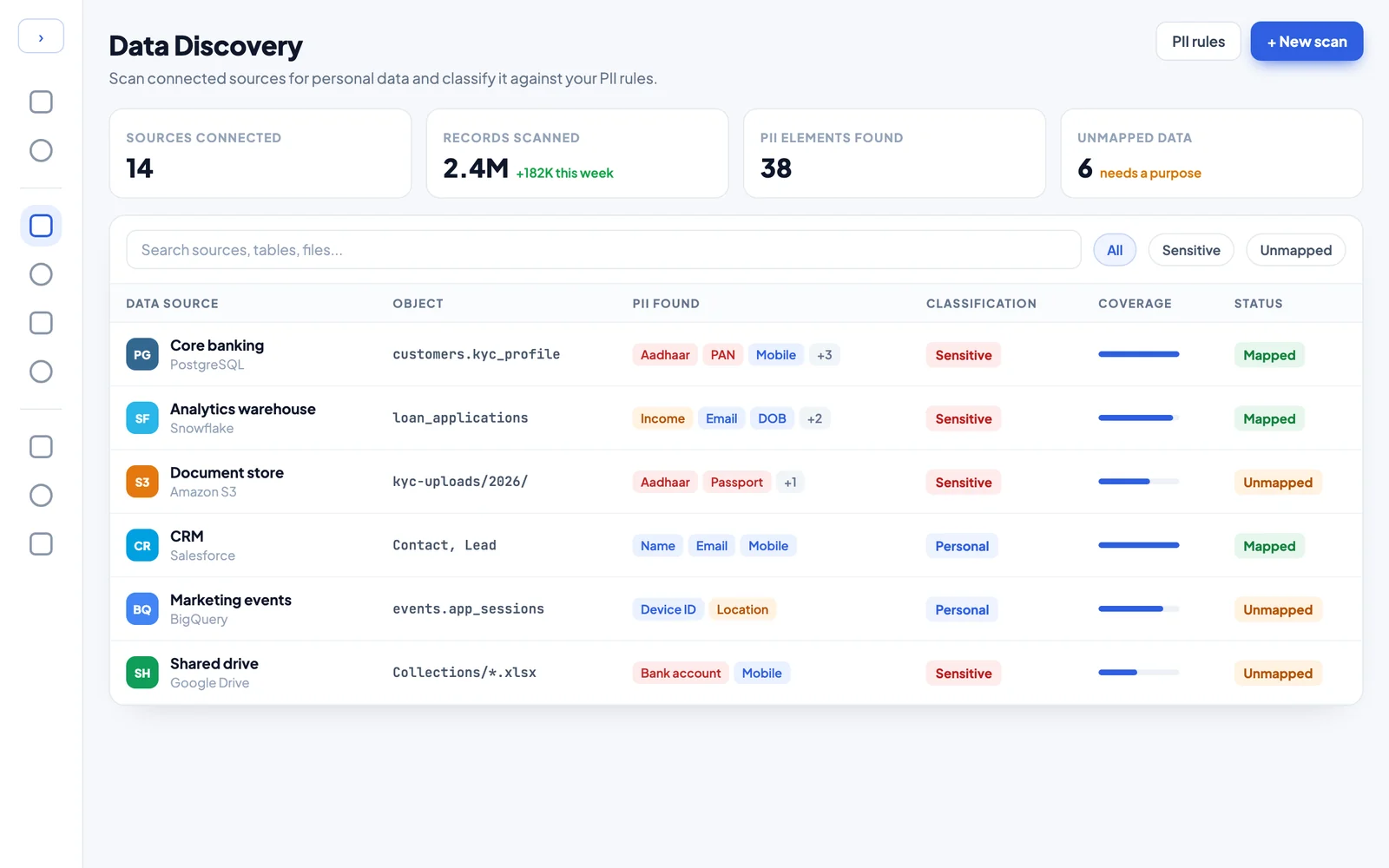
You can only protect the personal data you know about. CoTrust scans your cloud accounts, databases, SaaS tools and file stores, finds the personal data in them and labels it, down to Indian identifiers like Aadhaar, PAN and UPI IDs. It runs inside your environment, read-only, so raw personal data never leaves it.
Five Questions the DPDP Act Will Ask You
The Act puts these obligations on your organisation as the Data Fiduciary, and most of them apply from 13 May 2027. A gap analysis on paper rarely answers them. Each one needs you to know where your personal data actually is.
| The question | Why the Act asks it | What CoTrust gives you |
|---|---|---|
| Where does our sensitive personal data live? | You must protect it with reasonable security safeguards, and describe it in your notice | A live inventory across cloud, SaaS, databases, endpoints and file stores |
| Which processors and third parties receive it? | A person can ask who you shared their data with | A map of where data leaves your systems: KYC providers, credit bureaus, SMS and email platforms |
| Who consented to what, and does processing match? | Consent covers a specific purpose, and only that purpose | Each data store tied to the purposes in your records |
| Can we prove we erased it? | You must erase data once its purpose is served, and when a person asks | Every location of a person's data, so erasure reaches all of them |
| Can we scope a breach in 72 hours? | The Data Protection Board expects a detailed report within 72 hours | Which systems, which data categories and roughly how many people a breach touches |
Find Personal Data Across Every System
CoTrust scans continuously, so a new database or bucket shows up in your inventory without anyone filing a ticket. Your team sees where each kind of personal data sits, and which systems hold more than anyone expected.
- Cloud and on-premise: AWS, Google Cloud and your own data centre
- Databases and warehouses: PostgreSQL, MySQL, Amazon Aurora, Oracle, MariaDB, MongoDB, Redis, Snowflake, Databricks, BigQuery, Amazon Redshift, Amazon Athena, DynamoDB, Elasticsearch, Presto, Cloud SQL, Spanner, Bigtable and SQLite
- File and object storage: Amazon S3, Google Cloud Storage and network file shares
- SaaS tools: Google Workspace, Slack and GitHub
- Logs and endpoints: CloudWatch logs and managed devices
Exposure flags show whether a file is private, shared internally or open across the organisation.
Read the guideDPDP compliance platform: what to look for →
Classification Built for Indian Personal Data
CoTrust's machine learning models were trained on Indian personal data, so they recognise a UAN, a UPI ID or an Aadhaar VID as readily as an email address. CoTrust also reads scanned KYC documents with OCR, so a PAN card image in a storage bucket gets the same label as a PAN in a database column.

| Category | What CoTrust labels |
|---|---|
| Identity | Aadhaar number, Aadhaar VID, PAN, CKYC number, passport, voter ID, driving licence, date of birth, gender |
| Financial | Bank account number, IFSC, MICR, UPI ID, credit card, demat account, income data, GSTIN |
| Employment and company | PF number, UAN, CIN, DIN |
| Sensitive | Health data, biometric data, religion |
| Contact and device | Mobile number, email, address, IP address, MAC address, IMEI |
| Vehicle | Registration certificate, engine number, chassis number |
You can tune the labels for your industry, so a lender, an insurer and an online retailer each see the categories that matter to them. Your security, legal and data teams then read the same labels when they decide what to protect, restrict or erase.
See Where Personal Data Goes
CoTrust also reads your code repositories and API surfaces to find where personal data is sent out: the KYC provider, the credit bureau, the SMS gateway, the email platform. It also flags code that writes personal data into logs, one of the most common ways personal data leaks.
CoTrust scans every external endpoint your systems send personal data to, in real time, and shows them in one view. For a typical lender, that list starts with:
- CIBIL, for credit checks
- Digio eSign and DigiKYC, for signing and identity verification
- Exotel and GupShup, for calls, SMS and WhatsApp
- Mailchimp, for email campaigns
Most lenders find several more. Together, these endpoints make up the list of processors and third parties your access requests and your ROPA need to name.
See Who Can Reach It
CoTrust reads identities and permissions from your cloud IAM, Okta, Active Directory and database roles, and works out who can actually reach each store of personal data. It flags two things access reviews tend to miss:
- Combinations of permissions that are harmless on their own and risky together
- Dormant accounts that still hold access to personal data
Findings Ranked by Risk and Sent to the Right Owner
Every finding gets a risk score from a fixed formula, so the same inputs always give the same score and your team can see why something ranked high. Findings go to the owner of the system and can raise alerts in Slack, Splunk, Coralogix or email.
CoTrust also connects to the tools you already run: CSPM, SIEM, ticketing, DLP and EDR.
Build Your Data Inventory for DPDP Compliance
The inventory is where the rest of your DPDP work starts. It shows your team what to record in your ROPA, what your notices need to describe, and where to look when someone asks to see or erase their data. You can export a ROPA straight from it, run breach-scoping drills against it, and produce readiness reports for your steering committee or board.
Read the guideROPA for DPDP: how to build your Record of Processing Activities →
Three-Plane Architecture: Raw Data Never Leaves Your Environment
A discovery tool has to look at your most sensitive data, so where it runs matters. CoTrust splits the work across three planes and draws the trust boundary so that raw personal data never crosses it.
| Plane | Where it runs | What it does |
|---|---|---|
| Data plane | Inside your environment | Scanners run in your cloud accounts, databases, SaaS connections and managed devices. A six-layer classification pipeline labels personal data where it sits, with OCR for documents in storage. Code, identity and access scanners read your repositories, IAM, Okta, Active Directory and database roles. Read-only, always, and it makes no outbound calls except through the gateway. |
| Edge gateway | Inside your environment | The single point where anything leaves. It uses mutual TLS, filters every outbound message with tripwires for raw personal data, holds results safely if the link to Digio drops, flags unusual data volumes, and keeps its own tamper-proof log. Its kill switch pauses all scanning within seconds. |
| Control plane | Managed by Digio | Holds the asset graph, findings, risk scores, versioned classification rules and reports, and sends webhooks to your tools. It receives only classifications, metadata and fingerprints. Your team signs in through your identity provider, with OIDC or SAML and role-based access, and every action goes into an immutable audit log. |
The control plane also connects discovery to CoTrust's consent management, so what you find and what people agreed to sit side by side.
Digio is SOC 2 and ISO 27001 certified.
Where Discovery Fits Next to the Tools You Already Run
Most enterprises already run some of these tools. Each one answers part of the DPDP questions above.
| Tool | What it does | What it misses |
|---|---|---|
| DLP | Watches data in motion | Data at rest, and what kind of personal data it is |
| Cloud security posture (CSPM) | Finds cloud misconfigurations | The personal data inside the storage it checks |
| GRC tools | Track documented controls | What is actually happening in your systems today |
| Consent and DSR tools | Keep consent records and handle requests | The data itself |
| Data catalogs | Inventory data for analytics | Security and compliance use |
CoTrust fills that gap, and it is part of the same platform as CoTrust's consent management and data principal rights.
What Changes After Deployment
| Measure | Target | Typical result |
|---|---|---|
| Sensitive data stores covered | 95% or more | 97% to 99% |
| Time to detect a new data store | Under 24 hours | Under 6 hours |
| Time to answer a data principal request | Under 24 hours | Under 1 hour |
| Time to scope a breach | Under 24 hours | Under 6 hours |
| False positives in routed findings | Under 10% | 5% to 8% |
| Fall in high-severity findings over 6 months | 30% or more | 40% to 60% |
Run CoTrust as SaaS or on Your Own Servers
The SaaS version is a cloud-based platform with a flat recurring fee. The on-premise version installs on your local servers, with pricing based on the number of profiles and connectors.
See it before you commit. Book a 60-minute walkthrough on a sample banking or e-commerce environment, or a 30-day readiness assessment that runs on your own systems and gives you real findings.
Trusted by 2,500+ enterprises
Banks, lenders, brokers and fund houses already run Digio in their customer journeys, reaching 100 million+ individual users.




















 ISO/IEC 27001
 SOC 2 Type II
- Data residency in India
- Cloud or air gapped on premise
Questions About Data Discovery Under the DPDP Act
Does the DPDP Act require data discovery?
Not by name. The Act asks you to describe the personal data you collect, protect it, erase it once its purpose is served, and report a breach. Each of these depends on knowing what you hold and where.
Does our personal data leave our environment?
No. CoTrust's scanners classify data inside your environment, and a gateway you host filters everything that leaves. Digio receives classifications, metadata and fingerprints, never the raw data.
Which Indian identifiers can CoTrust detect?
Aadhaar number and VID, PAN, UPI ID, GSTIN, CKYC, bank account and IFSC, PF number and UAN, voter ID, passport, driving licence and more, plus health, biometric and religious data. It also reads scanned KYC images with OCR.
How is this different from a DLP tool?
DLP watches data as it moves. CoTrust finds and labels personal data at rest, maps where it flows and who can reach it, and ties it to your DPDP records.
Can CoTrust discover data in on-premise systems?
Yes. CoTrust covers on-premise, cloud and hybrid environments, and you can run CoTrust itself on your own servers.
How does data discovery connect to ROPA?
CoTrust builds your Record of Processing Activities from what discovery finds, and you can export it directly. Your team then adds the purpose, recipients and retention period for each processing activity.
Try first. Subscribe later.
Digitally transform business operations with Digio!
Learn how Digio can enhance your business productivity
Get 1-on-1 business use case solutioning
Speak with our business consultants to get a solution walkthrough for your business requirement
Test the APIs
Let your development team test our API suite to understand configurability and product integration
Subscribe
Get the best in industry commercials for your business usecase