

Loading website
00%
Data Breach and Incident Management for DPDP with
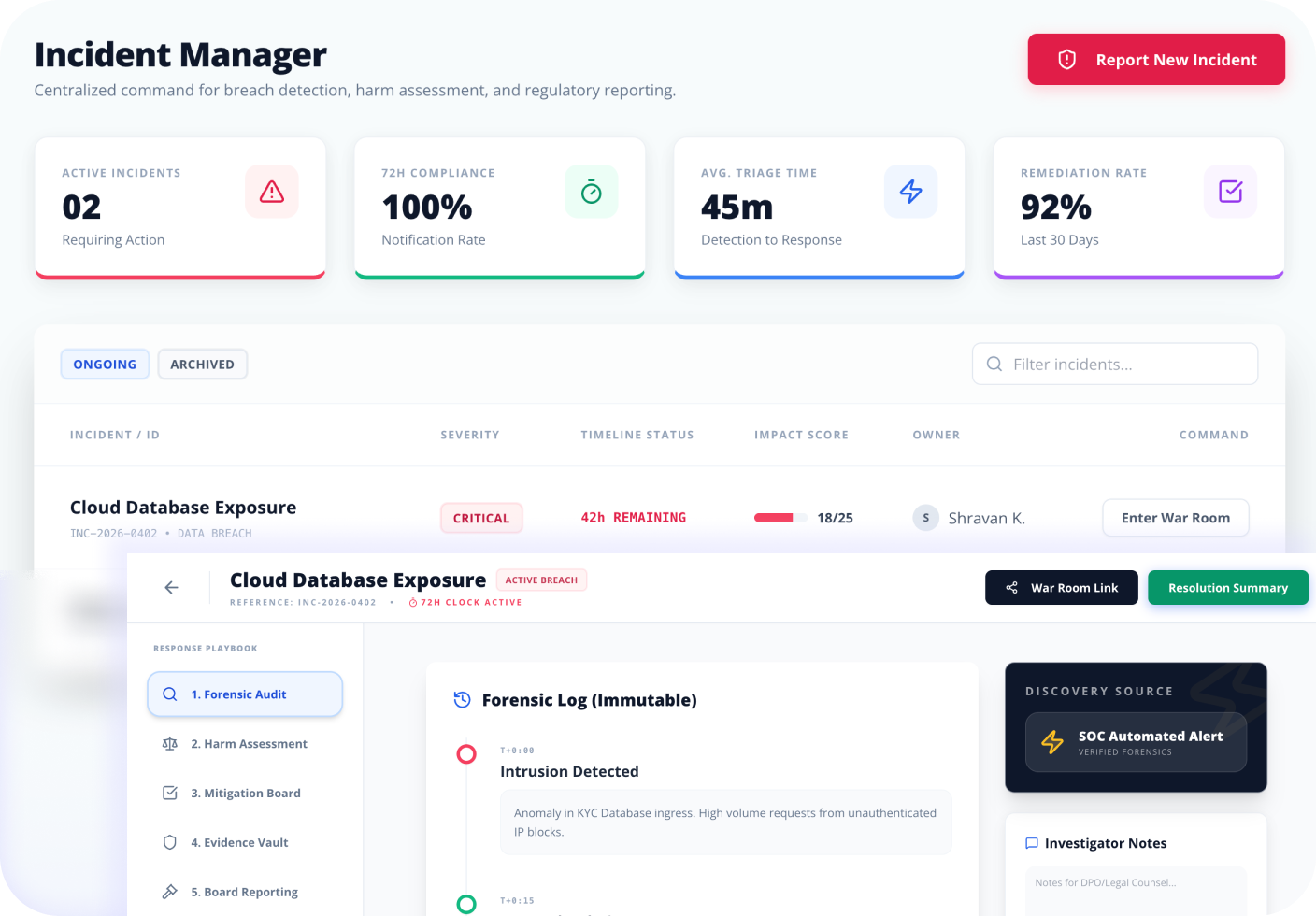
When a breach happens, the reporting clock starts before you know how big it is. CoTrust connects to your breach detection tools, opens a response room for each incident, works out which data and which people are affected, and tracks the reports you owe the Data Protection Board and CERT-In. Run it as SaaS or on your own servers.
What the DPDP Act Asks, and Where CoTrust Fits
These obligations sit with your organisation as the Data Fiduciary. CoTrust gives your teams the technology to carry them out. Most obligations apply from 13 May 2027.
Take reasonable security safeguards to prevent a personal data breach
Catalogues every incident, so your team can close the gap behind each one
Inform the Data Protection Board of a breach without delay, with a detailed report within 72 hours
Tracks each report against its deadline
Inform each affected Data Principal
Keeps that step in the incident's workflow
The First 72 Hours, Step by Step
| When | What happens in CoTrust |
|---|---|
| Detection | Your SIEM or another breach detection system raises the incident, and CoTrust opens a response room for it |
| First hours | The response team is assigned, the CERT-In report is prepared, and containment tasks are opened |
| Scoping | CoTrust shows the affected systems, the data categories they hold and roughly how many people that touches |
| Without delay | The Data Protection Board and the affected Data Principals are informed |
| Within 72 hours | The detailed report goes to the Board, with the mitigation tasks it commits you to |
| Afterwards | Mitigation tasks are tracked to closure, and the incident is catalogued for next time |
A War Room for Every Incident
CoTrust connects to the breach detection systems you already run. When one raises an incident, CoTrust opens a response room for it: who is on it, what has been found, what is still open. Your blue team can configure how incidents are catalogued, so each one is recorded the same way and patterns across incidents are easy to see. Alerts reach the team where it already works: Slack, Splunk, Coralogix or email.
Scope the Breach Fast
The detailed report to the Board needs the nature, extent and impact of the breach. CoTrust works that out from what it already knows: which systems were affected, which data categories they hold, which processors received data from them, and roughly how many Data Principals that touches. In a typical deployment, breach scoping takes under 6 hours. Your team can rehearse with breach-scoping drills before a real incident.
What the Board's Report Needs
The DPDP Rules set out what the detailed report to the Data Protection Board has to contain. CoTrust collects each part as the incident runs, so your team can assemble the report well before the deadline:
- The facts of the breach: what happened, when, where and how it was found
- Its extent and its likely impact on the people affected
- What you have done to mitigate the risk
- What you know about who caused it
- What you are changing to prevent a repeat
- A record of how and when the affected people were informed
Reporting Deadlines: the Board and CERT-In
| Report to | Deadline | What CoTrust tracks |
|---|---|---|
| Data Protection Board | Intimation without delay, detailed report within 72 hours | The report, its contents and the mitigation tasks it commits you to |
| CERT-In | Within 6 hours of noticing a cyber security incident | The report and its mitigation tasks |
Both sets of mitigation tasks stay open until someone closes them, and CoTrust shows which are overdue.
Read the guideBreach reporting in the DPDP era →
Tell the People Affected
The DPDP Rules ask you to tell each affected person what happened, when, its likely consequences for them, what you have done about it, what they can do to protect themselves, and who to contact. CoTrust keeps that step in the incident's workflow, alongside the Board report.
A Response Trail You Can Show Later
Every incident keeps a detailed trail of what was detected, who did what, which reports went out and when. If the Board asks how you handled a breach months later, your team exports the trail. The same trail shows your auditor that mitigation tasks committed to CERT-In and the Board were actually completed.
External Threat Monitoring
With CoTrust's Govern plan, external threat monitoring and real-time data visibility add warning from outside your own systems, and access governance narrows who could cause the next incident. Data flow monitoring flags personal data heading to an unapproved destination.
What a Missed Obligation Can Cost
| Failure | Maximum penalty |
|---|---|
| Failing to take reasonable security safeguards to prevent a breach | ₹250 crore |
| Failing to inform the Board or affected Data Principals of a breach | ₹200 crore |
Read the guideDPDP compliance for banks: a CISO's 90-day roadmap →
Run CoTrust as SaaS or on Your Own Servers
The SaaS version is a cloud-based platform with a flat recurring fee. The on-premise version installs on your local servers, with pricing based on the number of profiles and connectors.
See it first. Book a 60-minute walkthrough on a sample banking or e-commerce environment, or a 30-day readiness assessment that runs on your own systems and gives you real findings.
Trusted by 2,500+ enterprises
Banks, lenders, brokers and fund houses already run Digio in their customer journeys, reaching 100 million+ individual users.




















 ISO/IEC 27001
 SOC 2 Type II
- Data residency in India
- Cloud or air gapped on premise
Questions About Data Breaches Under the DPDP Act
How soon must a breach be reported under the DPDP Act?
The DPDP Rules ask you to inform the Data Protection Board without delay, and to send a detailed report within 72 hours of becoming aware of the breach. You must also inform each affected Data Principal without delay.
Do we also report to CERT-In?
Yes, if the breach is also a cyber security incident. CERT-In expects a report within 6 hours of noticing it. CoTrust tracks both reports in the same incident.
What counts as a personal data breach?
Under the Act, any unauthorised processing of personal data, or its accidental disclosure, acquisition, sharing, use, alteration, destruction or loss of access, that compromises its confidentiality, integrity or availability.
What is the penalty for a data breach under the DPDP Act?
Up to ₹250 crore for failing to take reasonable security safeguards, and up to ₹200 crore for failing to inform the Board or the affected people.
What must we tell the people affected?
What happened and when, the likely consequences for them, what you have done to reduce the risk, what they can do to protect themselves, and who they can contact.
Can we practise before a real breach?
Yes. CoTrust supports breach-scoping drills, so your team can rehearse working out what was affected against your real systems.
Which tools does CoTrust connect to during an incident?
The breach detection systems you already run, such as your SIEM, and the channels your team works in, including Slack, Splunk, Coralogix and email.
Explore More of CoTrust
- ProductData Flow MonitoringSee where personal data moves, and who touches it on the way.
- ProductData Discovery & ClassificationFind and classify the personal data in every system you run.
- ProductDPIAAssess the risk of new processing before it starts.
- PlatformCoTrust overviewThe whole platform, from discovery to proof.
Try first. Subscribe later.
Digitally transform business operations with Digio!
Learn how Digio can enhance your business productivity
Get 1-on-1 business use case solutioning
Speak with our business consultants to get a solution walkthrough for your business requirement
Test the APIs
Let your development team test our API suite to understand configurability and product integration
Subscribe
Get the best in industry commercials for your business usecase