

Loading website
00%
DSAR and Data Principal Rights Management with
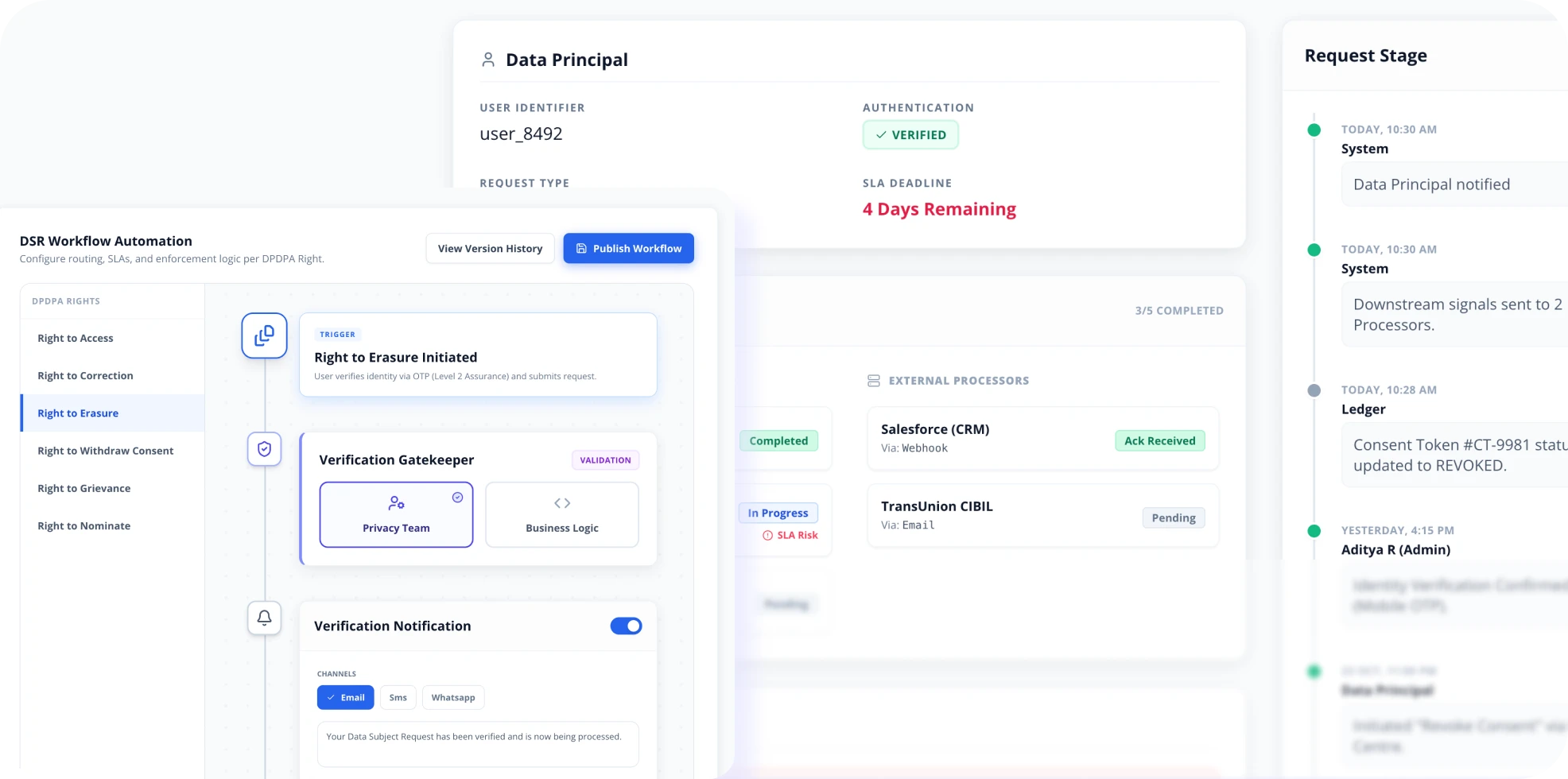
CoTrust puts every data principal request in one dashboard with its due date, and routes it through the workflow you design. Each right under the DPDP Act gets its own workflow: access, correction, erasure, withdrawal of consent, nomination and grievance. Run it as SaaS or on your own servers.
What the DPDP Act Asks, and Where CoTrust Fits
These obligations sit with your organisation as the Data Fiduciary. CoTrust gives your teams the technology to carry them out. Most obligations apply from 13 May 2027.
Let people access, correct and erase their data, nominate someone, and raise a grievance
Puts every request in one dashboard with its due date, and routes it through the workflow you design.
DSAR workflowsPublish how people can make a request, and how long you take to resolve a grievance
Gives people a request form in your privacy centre, and tracks each request against the period you set.
DSAR formDSAR Software Built Around the DPDP Act
DSAR is the GDPR term. The DPDP Act calls these the rights of the Data Principal. CoTrust gives your team rule specific workflows, with Data Principal identity verification, custom business logic checks, SLA driven escalations and team level request management.
How a DSAR Request Moves Through CoTrust
- The person submits a request through your privacy centre.
- CoTrust verifies their identity, for example by OTP.
- Your privacy team or business logic reviews it, then approves or rejects it.
- Approved requests go to your databases, CRM, data warehouse and processors.
- The person gets an update at each step, by email, SMS or WhatsApp.
Each request shows its SLA deadline, its stage and who has completed their part, with escalations when a deadline is at risk. Webhooks push request status into the tools your teams already use, such as Slack or your ticketing system, so each team sees updates where it already works.
Read the guideRight to erasure under DPDP →
Find Every Copy Before You Answer
An access request asks for a summary of a person's data and who you shared it with. An erasure request means removing it everywhere. Both depend on knowing every system that holds the person's data.
CoTrust's data discovery already knows where each kind of personal data lives, across databases, warehouses, SaaS tools and logs, and which processors receive it. So a request reaches every system that holds the person's data, and the access summary can name the processors you shared it with.
A Trail for Every Request
Every request keeps a record of who verified it, who approved it, which systems acted on it and when the person was told. If a regulator or the person asks how a request was handled, your team exports the trail.
DSAR Form and Response Templates
You choose which actions people can take and which fields your access form asks for, so your team gets what it needs to identify the person. CoTrust lets you set the message for each notification, so every update uses wording your team has approved.
The Rights CoTrust Handles
| Right | What the person can ask for |
|---|---|
| Access | A summary of their personal data and your processing activities, and who you shared it with |
| Correction | Correction, completion or updating of their personal data |
| Erasure | Erasure of their personal data, unless the law requires you to keep it |
| Withdrawal of consent | An end to processing based on the consent they gave |
| Nomination | Someone to exercise their rights if they die or cannot do so |
| Grievance | A response through your grievance system, within the period you publish, up to 90 days |
Run CoTrust as SaaS or on Your Own Servers
The SaaS version is a cloud-based platform with a flat recurring fee. The on-premise version installs on your local servers, with pricing based on the number of profiles and connectors.
Trusted by 2,500+ enterprises
Banks, lenders, brokers and fund houses already run Digio in their customer journeys, reaching 100 million+ individual users.




















 ISO/IEC 27001
 SOC 2 Type II
- Data residency in India
- Cloud or air gapped on premise
Questions About Data Principal Rights Under the DPDP Act
What is a DSAR under the DPDP Act?
DSAR stands for data subject access request, which is the GDPR term. Under the DPDP Act, a Data Principal can ask for a summary of their data and exercise rights to correction, erasure, nomination and grievance redressal. CoTrust manages each of these as a workflow.
How long do you have to respond to a grievance?
The DPDP Rules ask you to publish your own grievance period, up to a maximum of 90 days. CoTrust tracks requests against the period you set.
How does CoTrust verify who is making a request?
CoTrust verifies identity before a request moves forward, for example by OTP. Your team can then add custom business logic checks.
Does CoTrust complete the request in other systems?
Approved requests go to your databases, CRM, data warehouse and processors through the workflow you design, and your team can see which have acknowledged them.
Can CoTrust find a person's data across all our systems?
Yes. CoTrust's data discovery maps where each kind of personal data lives and which processors receive it, so access and erasure requests reach every system that holds it.
Can request updates reach our team's tools?
Yes. Webhooks send request status to the tools your teams use, such as Slack or a ticketing system, and each team sees the requests waiting on it.
Try first. Subscribe later.
Digitally transform business operations with Digio!
Learn how Digio can enhance your business productivity
Get 1-on-1 business use case solutioning
Speak with our business consultants to get a solution walkthrough for your business requirement
Test the APIs
Let your development team test our API suite to understand configurability and product integration
Subscribe
Get the best in industry commercials for your business usecase