

Loading website
00%
Enterprise ROPA for DPDP with
A Record of Processing Activities lists the personal data you process, why you process it, who receives it and how long you keep it. CoTrust builds it from the personal data it finds in your systems and keeps it current as purposes change. Run it as SaaS or on your own servers.

What the DPDP Act Asks, and Where CoTrust Fits
These obligations sit with your organisation as the Data Fiduciary. CoTrust gives your teams the technology to carry them out. Most obligations apply from 13 May 2027.
Describe the personal data you collect and the purpose in your notice
Holds each purpose and the data behind it, and feeds both into your consent notices
Tell a person how their data was processed and who you shared it with, when they ask
Records every processing activity and its recipients, so an access request can be answered from the record
Erase personal data once its purpose is served
Stores a retention period for each activity
For Significant Data Fiduciaries: a DPIA and an independent audit
Gives the assessment and the auditor one record to start from
What Goes Into a DPDP ROPA
| Field | What it records |
|---|---|
| Processing activity | What you do with the data, such as onboarding, lending decisions or marketing |
| Purpose | Why, in the words your notice uses |
| Lawful basis | Consent, or one of the legitimate uses the Act allows |
| Data categories | Which kinds of personal data, down to Aadhaar number, PAN or bank account |
| Data Principals | Whose data: customers, employees, applicants |
| Systems | Where the data is stored |
| Recipients | The processors and other parties that receive it |
| Retention period | How long you keep it, and when it is erased |
One ROPA Entry, Worked Through
Here is what a single entry looks like for a lender's loan onboarding, the kind of activity most BFSI ROPAs start with.
| Field | Loan onboarding |
|---|---|
| Purpose | Verify the applicant and assess their creditworthiness |
| Lawful basis | Consent, captured at application |
| Data categories | Name, mobile number, PAN, Aadhaar number, bank statements, income data, credit score |
| Data Principals | Loan applicants and co-applicants |
| Systems | Loan origination database, document store with KYC images, data warehouse |
| Recipients | KYC provider, credit bureau, eSign provider, SMS gateway |
| Retention period | The period RBI's record-keeping rules require, then erased |
CoTrust fills in most of this entry for you: the systems and data categories come from data discovery, and the recipients from the flows CoTrust sees leaving your applications. Your team adds the purpose and the retention period, and checks the rest.
Where Spreadsheet ROPAs Go Wrong
Most ROPAs fail in the same few ways, and every one of them shows up later in an access request or an audit:
- They are written once and never updated, so a new product or vendor never makes it in
- They leave out SaaS tools, marketing pixels and analytics scripts
- The purposes are worded one way in the ROPA and another way in the notice
- They list recipients by department, so the vendors that actually receive the data go unnamed
- They leave retention periods blank, so data stays long after its purpose is served
CoTrust is built to close each of these gaps.
Start From the ROPA You Already Have
Most teams already have a ROPA in some form, often a spreadsheet per department. Bulk import it into CoTrust and work from there. The gaps show up quickly once it sits next to what CoTrust finds in your systems.
Read the guideROPA for DPDP: how to build your Record of Processing Activities →
Built From Your Systems
CoTrust checks your ROPA against what runs in your systems.
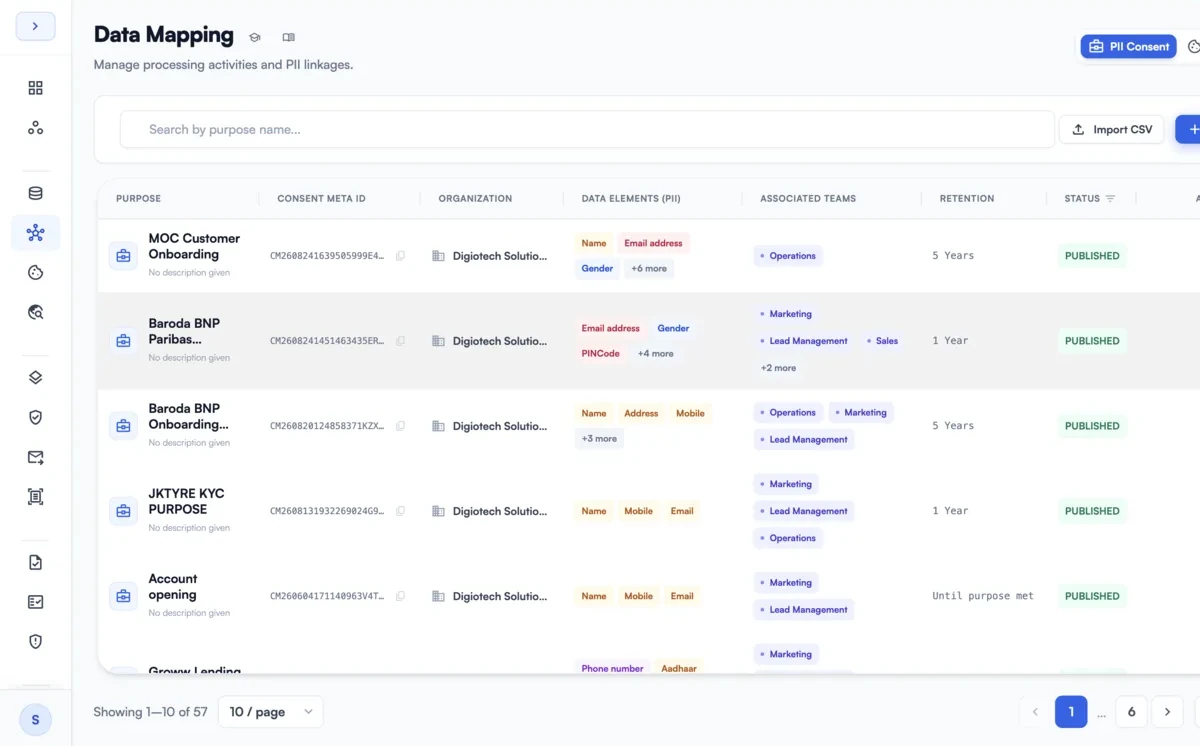
- Data discovery finds the databases, file stores and SaaS tools that hold personal data, including unlisted ones, and covers 97% to 99% of sensitive data stores in a typical deployment
- Each type of personal data is mapped to the processor that receives it
- Third-party trackers on your website and app are found automatically, so marketing pixels make it into the record
- New data stores show up in under 6 hours on average, so the record stays current
You can export the ROPA straight from CoTrust's data inventory whenever an auditor or the board asks for it.
One Version of Every Purpose
Purposes change: a new product, a new vendor, a new use of old data. In CoTrust each purpose is version controlled. When your team updates one, the new version goes out to every privacy workflow that uses it, including consent notices and data principal requests. You can also show which version of a purpose applied on any date.
What Your ROPA Feeds
The ROPA is the record the rest of your DPDP work reads from.
| Work | What it takes from the ROPA |
|---|---|
| Consent notices | The purposes and data categories each notice has to describe |
| Access and erasure requests | Which activities used a person's data, and which processors to tell |
| DPIA | The activities to assess, starting with high-risk and sensitive ones |
| Vendor assessment | Which vendors handle which personal data |
| Breach response | Which activities and people a compromised system affects |
Because access requests read from the same record, CoTrust customers typically answer them in under an hour.
Read the guideOperationalizing DPDPA compliance with ROPA →
When to Build It
Digio's own timeline for an enterprise reaching the May 2027 deadline puts the ROPA first:
| When | What happens |
|---|---|
| October to December 2026 | Internal implementation, ROPA creation, customer rollouts and validation |
| January to March 2027 | Processors and partners brought in, for consent validation and ROPA capture across the ecosystem |
| April to June 2027 | DPDP compliance goes live, with internal audit reports to the IT steering committee and board |
| 13 May 2027 | Most obligations under the Act apply |
Starting the ROPA in late 2026 leaves the first quarter of 2027 for bringing in processors and partners.
Run CoTrust as SaaS or on Your Own Servers
The SaaS version is a cloud-based platform with a flat recurring fee. The on-premise version installs on your local servers, with pricing based on the number of profiles and connectors.
See it first. Book a 60-minute walkthrough on a sample banking or e-commerce environment, or a 30-day readiness assessment that runs on your own systems and gives you real findings.
Trusted by 2,500+ enterprises
Banks, lenders, brokers and fund houses already run Digio in their customer journeys, reaching 100 million+ individual users.




















 ISO/IEC 27001
 SOC 2 Type II
- Data residency in India
- Cloud or air gapped on premise
Questions About ROPA Under the DPDP Act
Does the DPDP Act require a ROPA?
Not by name. The Act asks you to describe personal data and purposes in your notice, tell a person how their data was processed and who received it, and erase data once its purpose is served. A ROPA is the record that lets you do all three, and Significant Data Fiduciaries need it for their DPIA and audit.
Can we import the ROPA we already have?
Yes. CoTrust bulk imports an existing ROPA, so you start from your current record and fill the gaps from there.
How does CoTrust keep the ROPA up to date?
Data discovery runs continuously, so new data stores and trackers show up as they appear. Each purpose is version controlled, and an update reaches every workflow that uses it.
How is a ROPA different from a data inventory?
A data inventory shows where personal data is. A ROPA records why you process it, on what basis, who receives it and how long you keep it. CoTrust builds the inventory first and the ROPA from it.
Who should own the ROPA?
Usually the privacy or compliance team, with each business owner signing off their own activities. CoTrust lets each owner see and update the activities they are responsible for.
Can we export the ROPA for an auditor?
Yes. You can export it straight from CoTrust's data inventory at any time.
Explore More of CoTrust
- ProductData Discovery & ClassificationFind and classify the personal data in every system you run.
- ProductDPIAAssess the risk of new processing before it starts.
- ProductVendor AssessmentAssess the vendors who process personal data on your behalf.
- PlatformCoTrust overviewThe whole platform, from discovery to proof.
Try first. Subscribe later.
Digitally transform business operations with Digio!
Learn how Digio can enhance your business productivity
Get 1-on-1 business use case solutioning
Speak with our business consultants to get a solution walkthrough for your business requirement
Test the APIs
Let your development team test our API suite to understand configurability and product integration
Subscribe
Get the best in industry commercials for your business usecase