

Loading website
00%
DPIA Software for DPDP with
A Data Protection Impact Assessment asks what could go wrong with a processing activity, for the people whose data it uses, and what you will do about it. CoTrust runs each DPIA as a project with your stakeholders, starts it from your ROPA, and tracks every mitigation until it is closed. Most assessments finish in under a week. Run it as SaaS or on your own servers.
What the DPDP Act Asks, and Where CoTrust Fits
These obligations sit with your organisation as the Data Fiduciary. CoTrust gives your teams the technology to carry them out. Most obligations apply from 13 May 2027.
Significant Data Fiduciaries: carry out a DPIA periodically
Runs each assessment as a tracked project, and keeps every past one
Significant Data Fiduciaries: appoint an independent data auditor
Keeps the assessments, decisions and mitigations an auditor asks for
Significant Data Fiduciaries: appoint a Data Protection Officer based in India
Gives the DPO one place to run and sign off assessments
Every Data Fiduciary: reasonable security safeguards
Brings high-risk processing to light before it causes harm
What a Significant Data Fiduciary Has to Do
The government notifies which Data Fiduciaries are significant, based on factors such as the volume and sensitivity of the personal data they process and the risk to the people it belongs to. Large banks, insurers, lenders and platforms should expect to be on that list. Once notified, a Significant Data Fiduciary has to:
- Appoint a Data Protection Officer based in India, who answers to the board
- Appoint an independent data auditor
- Carry out a DPIA and an audit once every twelve months, under the DPDP Rules
- Share the significant findings of both with the Data Protection Board
CoTrust gives the DPO and the auditor the same record to work from, so each yearly cycle builds on the last.
Which Processing Needs a DPIA
For a Significant Data Fiduciary, the DPIA is an obligation. For every other business it is the most direct way to find risk before a regulator or a breach does. CoTrust helps you assess:
- High-risk processing, such as credit decisions or large-scale profiling
- Sensitive personal data, such as health, financial and biometric data, and children's data
- AI applications that use personal data, including models trained on customer records
In BFSI, that usually means a new lending model built on alternate data, video KYC, a chatbot that reads customer records, a collections process that uses third-party agencies, or marketing analytics that combines data from several products.
Children's data needs particular care. The Act requires verifiable consent from a parent before you process a child's data, and bars tracking, behavioural monitoring and targeted advertising aimed at children. Any activity that might touch a child's data is worth assessing first.
Read the guideHealth data under DPDP: why hospitals and healthtechs face stricter rules →
What a DPIA in CoTrust Records
| Step | What your team records |
|---|---|
| The processing | What the activity does, with its purposes, data categories, systems and recipients drawn from your ROPA |
| Necessity | Why the activity needs this personal data, and whether less would do |
| Risks to people | What could go wrong for the people whose data is used, and how likely and serious it is |
| Safeguards | The controls already in place, and the ones still needed |
| Mitigation plan | Each fix, its owner and its due date |
| Sign-off | Who approved the residual risk, and when the activity is reviewed again |
Run Each DPIA as a Project
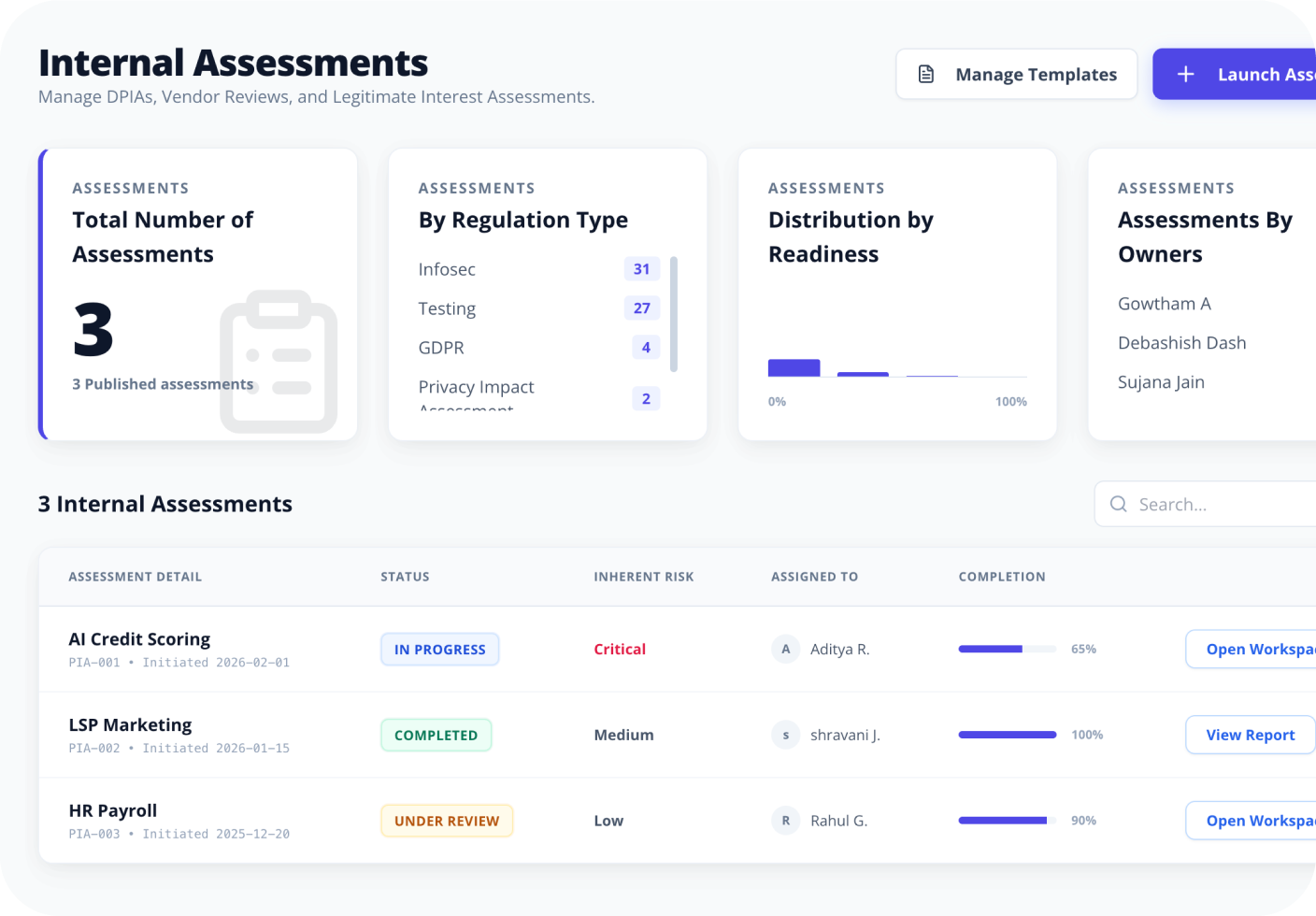
A DPIA needs legal, security, product and the business owner to agree. CoTrust lets you configure each assessment like a project: who contributes, who approves, what is due when. Each stakeholder sees what is waiting on them, and your privacy team sees where every assessment stands. That keeps most assessments to under a week.
Start From Your ROPA and Data Map
CoTrust starts each DPIA from your Record of Processing Activities and from what data discovery found: the purposes, the data categories, the systems and the recipients involved. Your team assesses the processing as it actually runs.
Track Every Mitigation to Closure
After the assessment, CoTrust keeps monitoring high-risk processing activities and logs each mitigation step: what was agreed, who owns it and when it was done. In a typical deployment, high-severity findings fall by 40% to 60% within six months.
Vendors Inside the Assessment
Much of your processing runs through vendors. CoTrust assesses vendors continuously, so a DPIA can see whether the processors involved still meet the Act's requirements today.
Evidence for Your Auditor and Board
Every assessment, decision and mitigation stays on record. When your data auditor, your board or the Data Protection Board asks how you assessed a processing activity, your team exports it. Digio's own timeline has the first internal audit report on DPDP compliance going to the IT steering committee in early 2027, and the second by mid-2027, so the record needs to exist well before the deadline.
Read the guideDPDP compliance platform: what to look for →
Run CoTrust as SaaS or on Your Own Servers
The SaaS version is a cloud-based platform with a flat recurring fee. The on-premise version installs on your local servers, with pricing based on the number of profiles and connectors.
See it first. Book a 60-minute walkthrough on a sample banking or e-commerce environment, or a 30-day readiness assessment that runs on your own systems and gives you real findings.
Trusted by 2,500+ enterprises
Banks, lenders, brokers and fund houses already run Digio in their customer journeys, reaching 100 million+ individual users.




















 ISO/IEC 27001
 SOC 2 Type II
- Data residency in India
- Cloud or air gapped on premise
Questions About DPIA Under the DPDP Act
Is a DPIA mandatory under the DPDP Act?
For Significant Data Fiduciaries, yes. The Act requires them to carry out a DPIA periodically, and the DPDP Rules set that at once every twelve months. Other Data Fiduciaries are not required to, but a DPIA is the clearest way to show your security safeguards are reasonable.
What is a Significant Data Fiduciary?
A Data Fiduciary the government notifies as significant, based on factors such as the volume and sensitivity of the personal data it processes and the risk to the rights of Data Principals.
How long does a DPIA take in CoTrust?
Most assessments complete in under a week, because CoTrust starts from your ROPA and data map.
Can CoTrust assess AI applications?
Yes. You can run a DPIA on any processing activity, including AI applications that use personal data.
Who signs off a DPIA?
Usually the Data Protection Officer, with the business owner of the activity. CoTrust lets you set the approvers for each assessment and records who approved what.
How often should a DPIA be reviewed?
At least once a year for a Significant Data Fiduciary, and whenever the processing changes: a new purpose, new data, a new vendor or a new model.
Can we reuse last year's DPIA?
Yes. Every past assessment stays on record, so a yearly review starts from last year's assessment and what has changed since.
Explore More of CoTrust
- ProductEnterprise ROPAA living record of every processing activity and its purpose.
- ProductVendor AssessmentAssess the vendors who process personal data on your behalf.
- ProductIncident ManagementReport a breach to CERT-In and the Board inside the deadline.
- PlatformCoTrust overviewThe whole platform, from discovery to proof.
Try first. Subscribe later.
Digitally transform business operations with Digio!
Learn how Digio can enhance your business productivity
Get 1-on-1 business use case solutioning
Speak with our business consultants to get a solution walkthrough for your business requirement
Test the APIs
Let your development team test our API suite to understand configurability and product integration
Subscribe
Get the best in industry commercials for your business usecase